




Abstract
Artificial intelligence (AI) has expanded its applications in water environmental systems, including urban drainage systems, wastewater treatment plants, natural aquatic systems, and constructed wetlands. Driven by advances in sensing technologies, the internet of things (IoT), and edge computing, water environmental management is shifting from experience-based practices toward data-driven decisions. Unlike existing reviews that focus on individual tasks or specific application scenarios, this review adopts a system-level perspective to examine AI applications across five core tasks—predictive modeling, pollution identification, intelligent control, multi-objective optimization, and knowledge discovery—within four water environmental systems. Attention is paid to how AI methods are distributed across tasks and system types. Based on a synthesis of literature statistics, this review summarizes the evolution of AI applications from prediction-oriented studies toward approaches emphasizing system control and optimization, and highlights closed-loop control, coordinated multi-objective optimization, and engineering-level edge deployment as key directions for future research.
Background
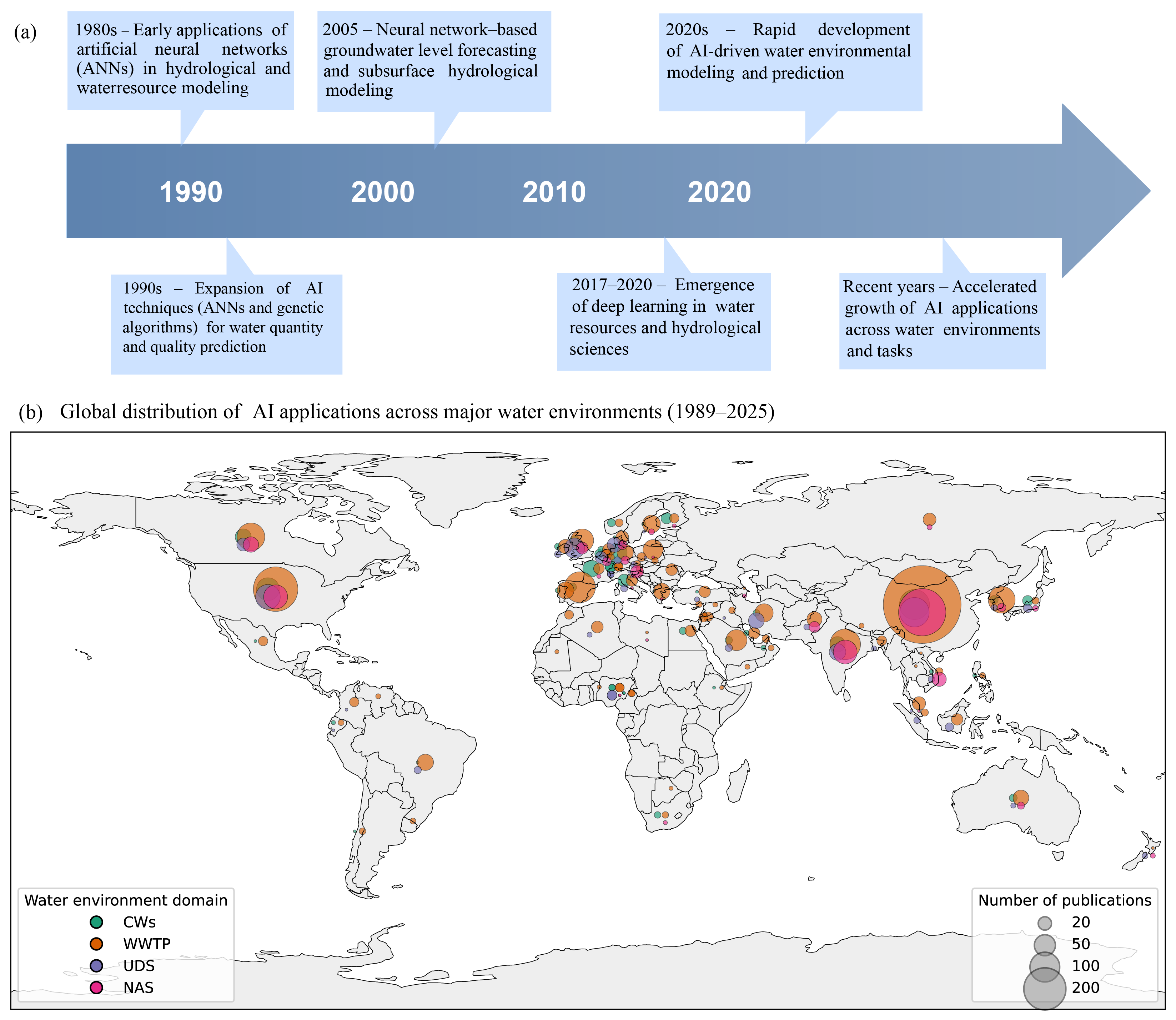
Historical evolution and global distribution of AI applications in water environmental research. (a) Conceptual timeline of the methodological evolution of AI in water environmental research. (b) Global distribution of AI-related publications across major water environment domains—constructed wetlands (CWs), wastewater treatment plants (WWTPs), urban drainage systems (UDS), and natural aquatic systems (NAS)—from 1989 to 2025, where marker size indicates publication volume.
Overview of Water Environmental Systems
Taxonomy of artificial intelligence (AI) methods applied in water environmental systems. The figure presents a hierarchical categorization of AI approaches into three primary paradigms: machine learning (ML), deep learning (DL), and reinforcement learning (RL). Representative algorithms are illustrated within each category. Machine learning includes classical methods such as linear regression, Bayesian models, k-nearest neighbors, support vector machines, XGBoost, and random forests. Deep learning covers convolutional neural networks (CNN), recurrent neural networks (RNN/LSTM), Transformer architectures, and graph neural networks (GNN). Reinforcement learning is shown separately to emphasize its closed-loop decision-making mechanism based on state–action–reward interactions.
AI Methods
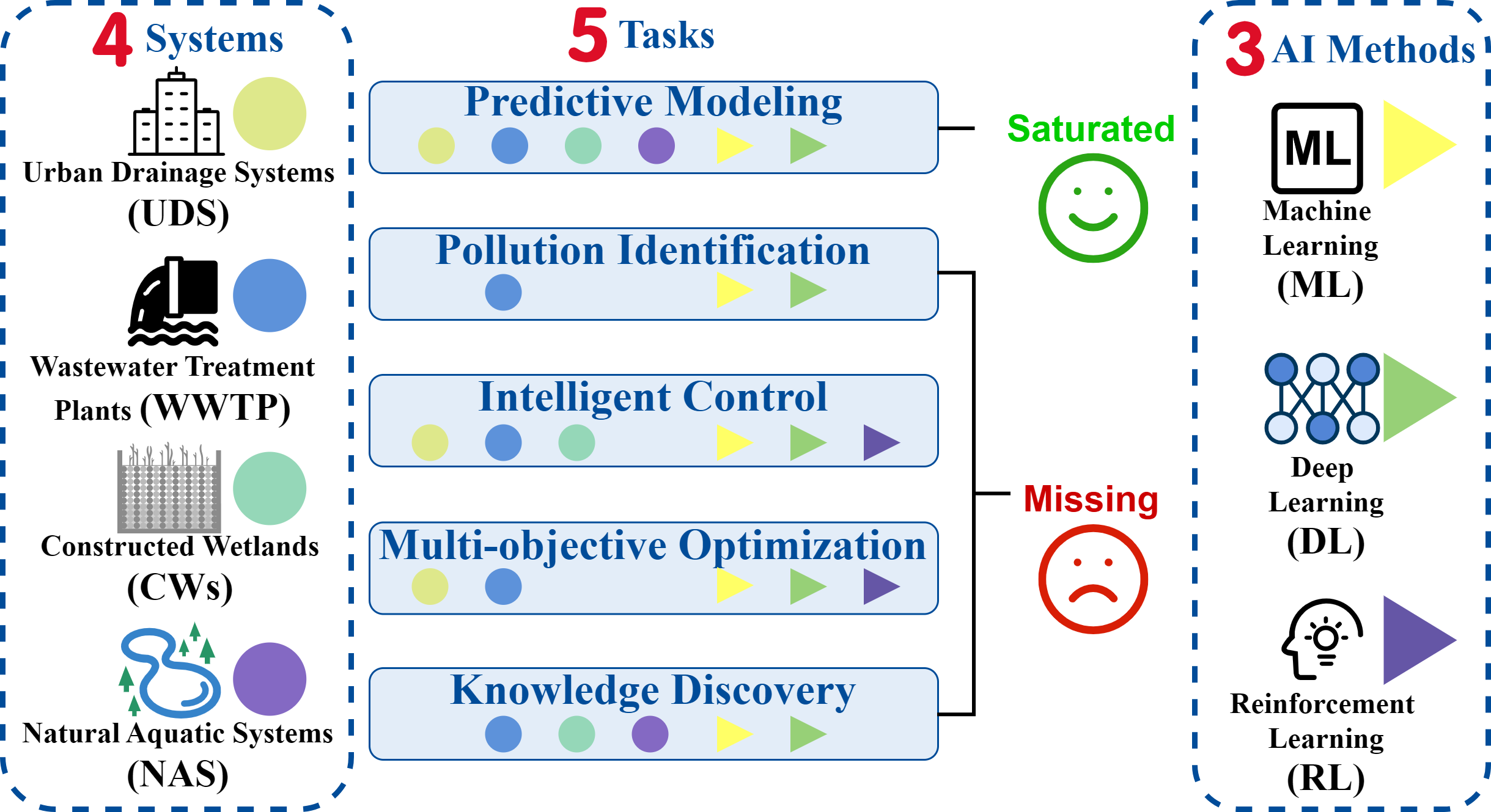
Color-coded mapping of artificial intelligence tasks and method categories across water environmental systems. The figure illustrates the relationships among four representative water environmental systems, five core AI tasks, and three major AI method categories. Colored circular markers denote task–system associations, with consistent colors indicating the corresponding system in which the task has been investigated. Triangular markers represent AI method categories (machine learning, deep learning, and reinforcement learning), with different colors distinguishing method types and indicating their associations with specific tasks. The absence of a marker suggests limited or no reported AI applications for the corresponding task–system or task–method combination.
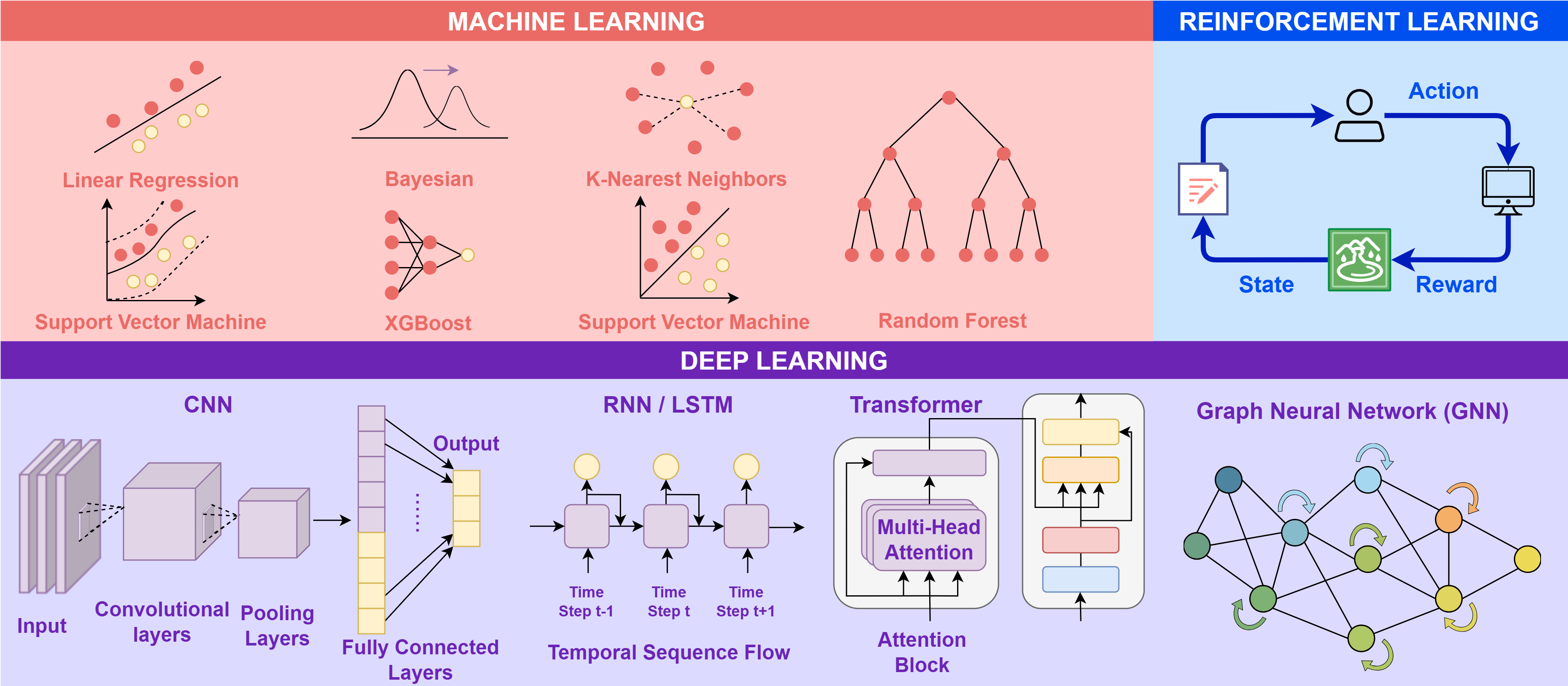
Taxonomy of artificial intelligence (AI) methods applied in water environmental systems. The figure presents a hierarchical categorization of AI approaches into three primary paradigms: machine learning (ML), deep learning (DL), and reinforcement learning (RL). Representative algorithms are illustrated within each category. Machine learning includes classical methods such as linear regression, Bayesian models, k-nearest neighbors, support vector machines, XGBoost, and random forests. Deep learning covers convolutional neural networks (CNN), recurrent neural networks (RNN/LSTM), Transformer architectures, and graph neural networks (GNN). Reinforcement learning is shown separately to emphasize its closed-loop decision-making mechanism based on state–action–reward interactions.
BibTeX
@article{YourPaperKey2026,
  title={A Survey of AI for Water Environmental Systems},
  author={Chun, Yang and Simin, Xu and Kele, Shao and Xihui, Guo and Wei, Zhi and Lingwei, Kong and Ling, Li and Huan, Wang},
  year={2026},
}